|
|
|
sign-up for
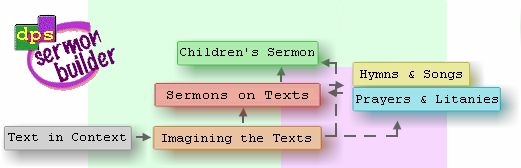
instant access via the DPS Sermon Builder
Palm / Passion Sunday
(cycle a)

Texts in Context |
Commentary:
Psalter;
First Lesson;
Epistle;
Gospel |
Prayer&Litanies
|
Hymns & Songs |
Children's Sermon |
Sermon based on Text |
Archived sermons by DPSers
Use links above or scroll down to review this week's resources
Special
DPS Resource:
Six Weeks of Daily Lenten Reflections, plus Easter week
by Nail-Bender
Please note that DPS is not accountable for the content
or availability of the following links:
General Season of Lent:
--History
of Palm Sunday from the Catholic Encyclopedia
--The
Season of Lent, Information
about the Christian Season of Lent from a Protestant
perspective
--Lent
disciplines and practices,
Lent, repentance, discipline, what true spirituality, by
SpiritHome.com---Journey
of Lent, six reflective Lenten lessons by
explorefaith.org
Liturgical Resources for Palm
Sunday:
--Palm
Sunday Liturgy from The Church of England
--A
Dramatic Reading Of The Passion Story A Kir-Shalom
offering by and from Rev. Rick Nelson
Fayette City - Concord United Methodist Charge
--Palm
Sunday Resources
by the United Methodist Church
General Board of Discipleship.
--Sermon
and Liturgy for The Sixth Sunday in Lent - Year A
Palm / Passion Sunday,
Richard Fairchild
--Daily
reflections: Palm Sunday
Other Palm Sunday Resources:
--The
History of Palm Sunday Abbot Gueranger
--About
Palm Sunday in the Byzantine Tradition at
Byzantine.Net (Byzantine Catholics on the Web).
--How
to Make Palm Crosses instructions from the King of
Peace Episcopal Church, Georgia.
--Palm
Sunday Crafts |
|
|
______________________________________________________
Palm / Passion
Sunday
The Liturgy of the Palms that remind us of Christs triumphal entry
into JerusalemMatthew 21:1-11 / Psalm 118:1-2, 19-29
Psalm 118:1-2, 19-29 Youll want to balance the psalm
readings over against the Gospel selection for the day. Here, the words from Psalm 118 are
chanted by the crowd as Jesus enters Jerusalem (which corresponds, for example, with
Matthew 21:9): Blessed is he comes in the name of the Lord!.
Matthew 21:1-11 Arranging for a donkey and colt, Jesus
enters Jerusalem on this occasion in a heavy-handed irony of kingship. (Matthew, always
with and eye for fulfillment interprets the Zechariah prophecy literally and thus Jesus
enters Jerusalem straddling two animals.) The crowd apparently senses the imminent
possibility of deliverance through this savior, for they draw from the song of pilgrimage
quoted about from Psalm 118, but adding an additional, Hosanna to the Son of
David.
The Liturgy of the Passion that suggest the suffering of
ChristIsaiah 50:4-9a / Psalm 31:9-16 / Psalm 22
Isaiah 50:4-9a is a servant song selected because it roughly
parallels Christs humiliation and shame. As one reads Isaiah 50: 5-9, it is nearly
impossible but to overhear the suffering of another Servant. While the Revised Common
Lectionary limits the lesson to the suffering servant, the Episcopal and RC lectionaries
augment the reading with verses 21-25texts which emphasize the triumph and victory
of the servant in terms not unlike that of Philippians 2.
Psalm 31:9-16 also moves the worshiper toward the shame and
suffering aspect of holy week: I am in distress . . . my eye wastes away from grief
. . . I am the scorn of all my adversaries, a horror to my neighbors . . .
Psalm 22 (RC and Episcopal lectionary) is also a lament that
points the worshiper like the others toward the alienation and desolation and suffering of
holy week.
______________________
Philippians 2:5-11An Example of Humility
Here we have the beautiful poetic story of Christ in the hymn found in
Philippians 2. Of interest during this Sunday is how this poetry can be read into the
actual experience of the historical Jesus around ACE 30 in Jerusalem. The hymn begins in
general pre-history (pre-creation ?) and becomes particularized in the person of Jesus
Christ. The movement is poignant and provides the larger theological landscape than just
what the palm/passion week can portray.
Matthew 26:14-27:66 / Matthew 27:11-54
Matthew 26 and 26 shadows Marks account of the passion. In this
passage the following episodes are included:
The passover / last supper
The prediction of a 100% desertion rate
The prayer gathering at Olivet
The betrayal by one of the Twelve
The trial before a Jewish court
Denial fulfillment: Peters denial
The suicide (Judas)
The releases (Barrabas)
The crucifixion
Matthews (unique): natural phenomena (45-53)
|
|
Matthew 21:1-11 (Liturgy
of
Palms)
|
All in a weeks work. Matthews
Day One: Jesus enters Jerusalem (21:1-9); cleanses the Temple (21:10-16);
leaves Jerusalem (21:17). Day Two: Jesus curses the fig tree and it dies
(21:18-22); Jesus questioned about authority (21:23-27); tells three parables
(21:28-22:14); responds to political and theological questions (22:15-46); judgment
discourse (23:1-25:46). Day Three: Jesus death plotted (26:1-5);
anointing in Bethany (26:6-13); Betrayal by Judas (26:14-16). Day Four: Preparation,
last supper, arrest, trial before Sanhedrin, Peters denial (26:17-75). Day
Five (Friday): Trial before Pilate, crucifixion, burial (27:1-61). Day Six: The
guard at the tomb (27:62-66). Day Seven: Discovery of empty tomb,
appearances, Great Commission (28:1-20).
- Matthew includes the oracle in Zechariah 9:9 (the LXX version of it) and introduces it
with a line from Isaiah 62:11, "Tell the daughter of Zion." Thus we have the
stage set for two animals and Jesus riding on them. Still, Matthews account makes an
important declaration to the churchs understanding of Jesus.

Recall moments when youve come upon
a public commotion and wondered, "what is this about?" "Who is this?"
Some of that emotion and confusion is mixed into the entry into Jerusalemlots of
questions being asked about who is riding into town.
- If you want to offer Palm Sunday to contrast the darker more somber tones of Holy Week,
then consider recalling in your worship and homily festive moments in life: Mummers, St.
Patricks day, attendance at a presidential event, a prayer and praise gathering, a
birthday party, a young man / woman returning back to their small community from a tour of
military duty.
- This passage is frequently picked as an example of how fickle and short-lived popularity
can be.
When the crowds cry
"Hosanna to the Son of David!" and "This is the prophet," they use the
right words, but they still miss the point. They have all of the notes and none of the
music. They have the theology straight, but they will still end up rejecting Jesus and
calling for his death (27:20-23). Matthew is striking a familiar note: Knowing the truth
is not the same thing as doing the truth (7:21). What one social psychologist said of
university students is also true of the kingdom: "It is possible to make an A+ in the
ethics course and still flunk life."
 Please see the
homily for this Sunday.
|
Matthew 26 and 27
(Liturgy of
Passion) |
Passion = intense emotion? Matthew 26 and
27 is referred to as the "passion" part of the gospel narrative. A logical
assumption might be that "passion" refers to the intense emotion that occur
during this fateful week. But the word has more to do with the word inactivity, passivity.
As one commentator points out,
. . . Jesus does not act but is acted upon.
He does not "die," but is killed, does not "rise" but is raised. In
the suffering and death of the Son of Man, human beings are the actors on the surface of
the narrative, and God is the hidden actor behind the scenes; in the resurrection, God
alone is the actor.
Matthew emphasizes four themes that has occurred
throughout his gospel: 1) prophetic knowledge of Jesus; 2) his dominance over the events
of the passion; 3) his status as Son of God, Son of Man, Messiah, and King; 3) his
fulfillment of messianic prophecy.
The Last Supper - the
Eucharist contains meaning not always
captured by words. Anamnesis says that the past is not really the past also the present to
those who "remember" as participant observers.
The Passover context that Matthew underscores already
points to the eucharistic meal as a way to remember the liberating act of God. The meal
points backward to the death of Jesus for the forgiveness of sins, and to
the life of Jesus in which he provided fellowship meals (cf. 9:10-13; 11:19; 26:6-13).
The Passover meal point forward to its
fulfillment in the kingdom of God. The fulfillment is nothing short of the messianic
banquet, but it also points from Jesus time to the time of the ekklesia which also
celebrates the messianic banquet every time bread is broken in remembrance of Christ. ]
The meal points inward as a call to
self-examination on the part of the participants. As other gospel writers and Paul,
Matthew evokes the response of self-examination.
The meal further points upward to the
heavenly realm where the risen and exalted Christ is enthroned. The symbols of body and
blood of Jesus now point beyond themselves to the transcendent realm. Matthew alone
preserves the enigmatic words "This is my body" and "This is my
blood;" without explaining how they are to be understood.
Finally, the meal points outward to the
whole church and to the world. While pauline theology and Lukes version are more
explicit, still Matthew includes concern for others in the eucharistic overtones of the
account of the feeding of the five thousand: "You [disciples give them [the
outsider crowds] to eat" (14:16).
Please
see the homily
"Never Said a Mumblin
Word" (for Christ the King Sunday)
LITURGY FOR ENTERING - This liturgical psalm of praise combines both corporate
and individual praise into a memorable, inspiring entrance poem celebrated by both
Christian and Jewish communities. The individual psalm of praise in found in vv. 5-14,
17-18 that leads up to our lesson. The liturgical action begins with v. 19-27, but
especially in vv. 20-24.
JUBILATION - The words that form this Sundays lesson gives us a hint of the vivid
and liveliness of ancient Israels worship-full of jubilation, happy shouting and
even dancing. Entry into the Temple (vv. 19-20) was a high and festal occasion,
accompanied with choirs singing in an apparent antiphonal style. [1] The stone which the
builders rejected has become the chief corner-stone (v. 22) is a phrase of which the
original meaning is all but lost to us, yet through the lens of the New Testament, the
saying becomes for Christians the aha of the gospel-surprise! the rejected one has become
the center of Gods saving activity.
NIB ON PSALM 118 - Psalm 118 can be seen as a focal point for discerning the
continuity between the Old and the New Testament witnesses that God is "for us"
(vv. 6-7; Romans 8:31) and that Gods "steadfast love endures forever" (vv.
1-4, 29; see Romans 8:38-39) . . . Not surprisingly, the special appeal that Psalm 118 had
for the Gospel writers has continued throughout the centuries of Christian interpretation
. . . Given the rich historical allusions and open-endedness of the psalm, as well as the
history and currency of its use in Judaism and Christianity, one might make the same
conclusion of Psalm 118 as a whole-all the saints have sung it and will sing it to the
end. [2]
Why
do you suppose that Luther called this his favorite psalm?
Do you feel part of a spiritual community that has gone through "distress"
(vv. 5-14)?
Who is the "us" in your "Lord, save us" (v. 25)? Where do you need
help right now?
This
psalm will typically combine with choirs, antiphonal calls and response, processions, and
great hymns like, All Glory, Laud, and Honor. On this day, Psalm 118 is majestic, festive
even as it foreshadows the gospel.
One homiletic idea might be to simply walk through the psalm as it connects with the
gospel accounts of Jesus triumphal entry into Jerusalem. EX: Shouts of joy and
victory (v. 15) could be heard in relationship to similar shouts among the throng that
welcomed Jesus into their city. You could conclude your meditation on the psalm where the
poem naturally ends: with the phrase, "Gods love endures forever" (v. 29),
for that phrase is the rock-bottom, powerful word of promise that God gives to all
generations.
_____________________________________
[1] Claus Westermann, The Living Psalms (Grand Rapids: Wm. B. Eerdmans, 1989), page
275.
[2] The New Interpreters Bible IV (Nashville: Abingdon Press, 1996), page 1156.
I AM IN DISTRESS - Most of the formulaic language in
this lament is shared throughout Jeremiah, Lamentations, and even from within the great
fishs belly by a lamentable Jonah: "I am in distress . . . my eye wastes away .
. . my strength fails." There are times in the rhythms of distressed life when such
prayers from deep within us.
CS LEWIS - The Father can be well pleased in that Son only who adheres to the Father
when apparently forsaken. The fullest grace can be received by those only who continue to
obey during the dryness in which all grace seems to be withheld. [2]
SUFFERING BECAUSE OF - The language of our lesson is open-ended; it seems to suggest
simultaneously grief, sickness, depression, and persecution. This descriptive language of
suffering is especially poignant in the phrase, "a broken vessel" (v. 12), or
more literally, "a perishing vessel." Perhaps despite-or because of his/her
suffering the psalmist is experiencing what is to be reserved for the wicked. Like
Jeremiah who also suffered because of his trust and his faithfulness in proclaiming
Gods word, so this psalmists very life is extinguished because of his/her
faithfulness to Gods will. [1]
St. John of the Cross describes
the lament periods of our spiritual journey as being a dark night of the soul (which is
also the title of his work). Succinctly stated, God sometimes allows us to feel abandoned
by God and all others so that we will grow in faithfulness regardless of our emotions. In
what way might this be at least somewhat true in your own spiritual journey?
On the continuum of 1. orientation (life is orderly and stable); 2. disorientation
(abrupt changes upset the equilibrium of our lives); 3. reorientation (some sense of
normalcy returns, but were never the same again), where do you find yourself at this
time in your life?
Begin with an anecdote about Dag
Hammarskjöld (Secretary-General of the Untied Nations and considered one of the most
outstanding and highly respected international leaders of the 20th century): "On his
travels around the world Hammarskjöld always took three items with him. These items were
found in his briefcase that was recovered after the plane crash that took his life in
September 1961: a copy of the New Testament, a copy of the Psalms and a copy of the United
Nations Charter."
Segue into Psalm 31-Hammarskjöld understood clearly that the book of Psalms presents
nothing short of Gods claim upon the whole world. Even when our world falls
apart-even when Christs world began to fall apart, the Psalms formed his final
words.
Describe the nature of lament-that over 60% of the psalms are lament; structure:
opening address, O Lord (or "Help!!!!") / Description of distress / Plea or
petition for Gods intervention / Reasons why God should jump in and help out /
glimmer of hope and confidence in God / Promise to do-be better as a result of Gods
deliverance.
Introduce St. John of the Crosss "Dark Night of the Soul" if familiar
with it
Shift to the passion of Christ - perhaps use the Gibson film as a way into the story of
Jesus; but get us there where we can hear-and see-Christs lament.
Offer the lament of Psalm 31 to become our place in times of suffering and hold out the
glimmer of hope that we find in vv. 19-24.
____________________________
[1] C.S. Lewis, in The Quotable Lewis, Wayne Martindale and Jerry Root, eds.
(Tyndale, 1989), p. 461.
[2] The New Interpreters Bible IV (Nashville: Abingdon Press, 1996), page 807.

Think this among you which also in Christ Jesus.
Thats the Greek text literally translated. How do we supply the missing verb? To
supply a to be verb points to the imitation of Christ, but Paul may have
instead wanted convey this idea: show among yourselves the attitude that arises from
the fact that you are in Christ. The difference is between a command to have
the attitude that was in Christ Jesus and the command to have an attitude that belongs to
those who are in him. That is, it is the difference between imitation and kergyma.
harpagmos (v 6)- something
to be grasped (NRSV). [ NIV = exploited; NLT = demand and cling to; TEV
= by force he should try to remain equal; Philips = did not cling to his
prerogatives as Gods equal. ] Apparently, much debate over the language and
meaning of this word; however, to be exploited seems closest to reaching
consensus-equality with God was something that Christ already possessed, but which he
chose not to use for his own advantage.
NIB:
Christ did not cease to be in the form of God when he took the form of a
slave, any more than he ceased to be the Son of God when he was sent into the
world. On the contrary, it is in his self-emptying and his humiliation that he reveals
what God is like, and it is through his taking the form of a slave that we see the
form of God.

This piece of early Christian hymnody could
move in two directions in a homily. First, the hymn provides a teaching about Christ. Like
Johns prologue, incarnation begins outside of time and space and becomes
particularized in our own time/space world.
The piece could also present for us Jesus
as the model of humility; the entire movement would have astonished readers of the first
century; such a heavenly narrative could never have resulted in a servants harness.
Yet, that very journey has inspired thousands of those who bear his name to follow down
that road of humility.
In either case this piece might
simply teach that This is the gospel. This is what God is like. This is what God has
done for you, and this is what God expects you to be like. Work out what that means
yourselves!
 For an example of
blocking a homily on this passage, please see the DPS homily archive for September 2,
2001.
C.R.
North has provocatively entitled this passage as The Gethsemane of the
Servant. What connections can you make between this third servant song and
Jesus preparation on the Mount of Olives for the suffering and death he knew was
imminent?
NIB:
It is difficult to judge whether these verses represent an
honest advance over any previous reflection on affliction, or whether they are a singular
response to a singular circumstance, no less profound for being so, but also difficult to
compare. This is not the LORD gave, and
the LORD has taken away; blessed be the name
of the LORD (Job 1:21); but neither is
it, cursed be the day on which I was born (Jer 20:13) or even heal me, O LORD, and I shall be healed (Jer 17:14).
The servant appears to understand his capacity to withstand assault as the embodiment of
obedience, I was not rebellious, I did not turn backward. (Isa 50:5).
Gethsemane is not a place. It is every place where the weary hunger for a word
that will sustain them when they are the target for abuse and shame. Perhaps you could
name several persons / scenarios of weariness and hunger; what word would sustain them?
For Isaiah the exile was Israels
Gethsemane-a place and time of great loss. A lost temple, the sign par excellence that God
was among them; a lost homeland which ensured the continuation of life and tradition as
they experienced it; loss of identity from being Gods favored and blessed people to
being a people scattered by an angry God.
NIB on connections . . .
. . . as tragedies go, the crucifixion of Jesus was
neither the worst nor was it even remotely a singular event in its time; many were such
executions in his day. What set it apart was that God had opened Jesus ears as to
its larger significance, allowing him the measure of confidence that did not remove the
anguish but made it bearable. It was the knowledge of . . . his obedience and his love for
those imperiled by evil . . . that kept him moving down that particular road and up a
cross. But behind was the voice of the one who sent him . . . That voice kept Good Friday
good and not another tragedy. It enabled that particular servant to empower
and inspire other servants, who would follow his lead and take up the cross God set aside
for them as well.
Begin a homily with a general discussion of suffering; why most people hate
suffering, how companies drive consumerism with products designed to alleviate even a
modicum of suffering.
Bring up several examples-general or
specific-of persons who have suffered
Raise the question about Jesus-another
example, though famous-of suffering; what makes his suffering any different?
Denouement: Shift to text-Isaiah suggests
that this suffering is with a difference; refer to the commentary above
(connections) how Jesus ears were opened to hear not just suffering, but
to hear through suffering and thus, to enter into his passion with obedience and courage.
You might close with another example-Martin
Luther King, Jr. or Oscar Romero.
|
____________________________________________________
Call to Worship:
L: Hosanna to the Son of David
P: Hosanna in the Highest
L: Blessed is the One who comes in the name of the Lord.
All: Hosanna in the highest
Call to Worship (based on Psalm 118):
L: The Lord is my strength and my power!
P: The Lord has become my salvation!
L: There are joyous songs of victory in the tents of the righteous
P: The stone which the builders rejected has become the cornerstone.
All: this is the day which the Lord has made, let us rejoice and be glad in it!
Collect
Almighty God, whose most dear Son went not up to joy but
first he suffered pain, and entered not into glory before he
was crucified: Mercifully grant that we, walking in the way
of the cross, may find it none other than the way of life and
peace; through Jesus Christ our Lord. Amen.
Opening Prayer
From our God who loves us with an everlasting love, who brings forth a new creation in Christ, who leads us by the Spirit in the wilderness: Grace and abundant mercy be with you all.
And also with you.
Let us pray. Almighty God, you sent your Son, our Savior Jesus Christ, to take our flesh upon him and to suffer death on the cross. Grant that we may share in his obedience to your will and in the glorious victory of his resurrection; through your Son, Jesus Christ our Lord, who lives and reigns with you and the Holy Spirit, one God, now and forever.
Amen.
Palm Sunday Prayer (based on the lections)
by Rev. Thomas Hall
God of unfailing Love,
We come before you on this day with thankful and joyous hearts
because your love knows no bounds. No boundaries, limits, or
obstacles—including those of our own making—can thwart your loving
kindness from following us all the days of our lives.
Yet during this week, your story of passion mirrors to us how we
have tested your love and spurned your compassion. You find no
abiding place in those who welcome you in God’s name during this
week; you are welcomed with short-lived praise and soon-aborted
allegiance.
We kneel before you in awe of the Mystery of your faithfulness.
We kneel before you with confession, acknowledging our complicity
with friends and enemies alike who through the ages have disowned
you through our words and actions. We kneel before you in gratitude,
forever thankful that even during passion week your love held
strong.
As we enter into Holy Week brace us with fortitude and gratitude
and with the assurance that you are with us, world without end.
Amen.
Short Palm Sunday Prayer
Almighty God, on this day, your son Jesus Christ entered the holy city of
Jerusalem and was proclaimed King by those who spread garments and palm branches along his
way. Let those branches be for us signs of his victory, and grant that we who bear
them in his name may ever hail him as our Lord, and follow him in the way that leads to
eternal life. In his name we pray. Amen.
Prayer for Illumination
Assist us mercifully with your help, O Lord God of our
salvation, that we may enter with joy upon the contemplation
of those mighty acts, whereby you have given us life and
immortality; through Jesus Christ our Lord. Amen.
Palm Sunday Blessing (Book of Common Worship)--palm branches
reqired
C: The Lord be with you.
P: And also with you.
C: Let us give thanks to the Lord our God.
P: It is right to give him thanks and praise.
It is right to praise you, Almighty God, for the acts of love by
which you have redeemed us through your Son Jesus Christ
our Lord. On this day he entered the holy city of Jerusalem in
triumph, and was proclaimed as King of kings by those who
spread their garments and branches of palm along his way.
Let these branches be for us signs of his victory, and grant that
we who bear them in his name may ever hail him as our King,
and follow him in the way that leads to eternal life; who lives
and reigns in glory with you and the Holy Spirit, now and for ever. Amen.
Prayer for a Walk in Christ's Passion.
Almighty and everliving God, in your tender love for the
human race you sent your Son our Savior Jesus Christ to take
upon him our nature, and to suffer death upon the cross,
giving us the example of his great humility: Mercifully grant
that we may walk in the way of his suffering, and also share
in his resurrection; through Jesus Christ our Lord, who lives
and reigns with you and the Holy Spirit, one God, for ever
and ever. Amen.
Closing prayer:
Almighty God, your Son came to us humbly on a donkey's back and now he sits exalted by
your right hand. As we enter into Holy Week contemplating your his path of
suffering, help us to become loyal and steadfast disciples, that we may always hear his
word, follow his teachings, and live in his Spirit. And prepare our hearts for that day
when every knee shall bow and every tongue confess that he is Lord and King, to your
eternal glory. Amen.
Closing prayer:
Great God, we come today to gather and scatter these branches of blessings.
With them we remember Jesus' joyous ride into Jerusalem,
where the hope of the many were gathered and lifted high.
Like those bearing the palms from so long ago,
we are gathered in celebration and rejoicing,
eager to greet the One who saves.
Bless these palms of remembrance and glory.
Bless our hearts as we relive the story.
And as those who cast their palms and their dreams
before a triumphant Christ,
may we lay down our lives before You,
so that our days would be your pathway
and our hearts, your open door.
|
____________________________________________________
Hymns:
Hosannah, loud Hosannah
All Glory Laud, and Honor
Alleluia, Alleluia
Lift up your Heads Ye mighty Gates
Be Joyful
All Hail the Power of Jesus Name
All Hail King Jesus
Lift High the Cross
Come Christians Join to Sing
Rejoice Ye Pure in Heart
All Praise to Thee, o King Divine
Victory in Jesus
Crown Him With Many Crowns
Crown Him King of Kings
At the Name of Jesus
Mantos Y Palmas (Filled with Excitement)
Precious Name
Jesus the Name High over All
Choruses:
This is the Day that the Lord has Made
Majesty
His Name is Wonderful
Lord I Lift Your Name on High
Lord, Our God, How Majestic
Hosannah, Hosannah
There is Something about that Name
He is exalted, the King is Exalted
He is Lord
Lamb of God
|
____________________________________________________________
Choose from
the following children's sermons
-
New: Making Jesus King,
by
Rev. Frank Schaefer
(see below)
-
Following Jesus Every Day, by
Rev. Frank Schaefer (please
scroll down)
-
Jesus and the Mule, based on Mark 11:1-11,
by Rev. Frank Schaefer
(please
scroll down)
_____________________________________________________________
Making
Jesus King,
a children's sermon based on the Triumphant Entrance
by
Rev. Frank Schaefer
props:
a number of little flags from your country; or, if you can find them,
flags from different countries.
Share the story of
Jesus riding into Jerusalem.
Explain to the
children why the people in the crowd waved palm branches, viz. that the
Palm branches were patriotic symbols. Had they had flags in those
days, they would have used them. In many processions
today we also see a lot of flags.
Hand out the flags to some of the kids and ask them to
wave the flags. The people wanted to
make Jesus King and Ruler over their country, Israel. Ask the kids
whether they feel the same way as the people felt back then. Do they
want to declare Jesus King over our country (or: if you use various
flags, the world)?
The truth is that we
cannot make Jesus King in our country or in the world today. But
we can claim our country (the world) for Jesus. We can declare today
that Jesus is King in our hearts, and then we invite other people to do
the same until the entire country makes Jesus king! But it all
starts with us today.
Prayer: "Dear King
Jesus, we declare you King and Lord of the earth and over our lives.
We give you our heart and our soul. Reign in our lives; be with us
every day and love and protect us. Thank you King Jesus!"
Following
Jesus Every Day
a children's sermon for Palm Sunday
by Rev. Frank Schaefer
Props: a fresh palm branch and a left-over branch from last year (if you don't have a
leftover one, you may want to make one: take a fresh one and put it in an oven until it is
brownish and dried up).
Good morning boys and girls. And what a great morning it is. Palm Sunday is
surely a great feast and a celebration in the church of Christ.. You know, on that first
Palm Sunday people welcomed and praised Jesus just as we are this morning. Only that
they actually saw Jesus riding in on a donkey. We kind of have to imagine that.
Wouldn't it be something if Jesus would ride in on a donkey right down the center isle
of our sanctuary? That'd be great! We could wave our palm branches at Jesus,
and shout: "Hosannah!" which is Hebrew for "Praise the Lord!" and we
could put our coats out for Jesus, like the people did on that first Palm Sunday.
Today I brought two things with me (show both palm branches). What are they?
That's right, I have two palm branches. Are they exactly alike?
No? What's the difference? You're right, one is a fresh palm branch and
the other one is old and dried up. That's because this one (wave the fresh palm
branch) is a fresh one and this one (wave the old palm branch) is one that we used a year
ago.
And do you know why I brought a fresh palm branch and an old one? Because we want
to remember that the people cried "Hosannah" and waved palms on Palm Sunday and
. . . only one week later, the same people turned away from Jesus and they pretended that
they didn't know him when he was hung on a cross to die.
And we want to remember that we, too, turn away from Jesus at times. You know, it
is easy to follow Jesus on Sundays when we go to Sunday school and church, but what about
during the week? During the week we often forget Jesus, and sometimes we do things
that are not Christian-like.
So the fresh palm branch can remind us that we should praise Jesus and the old palm
branch can remind us that we should not be like the people who turned away from Jesus.
We need to follow Jesus not only on Sundays but . . . all the time. And to do
that we need God's help. Let's pray that God will help us follow Jesus all the time.
Prayer: "Dear God, we thank you for Palm Sunday. We thank you for giving us
Jesus, who loves us so much. Help us to follow Jesus every day of our lives, and not
just on Sundays. Thank you, Lord. Amen.
Jesus and the Mule
a children's sermon based on Mark 11:1-11
by Rev. Frank Schaefer
props: palm branches; a youth volunteer to be the
donkey
Get one of the congregation's youth to act the part of a stubborn donkey.
Ask the kids for a volunteer to act the part of Jesus riding triumphantly into Jerusalem
(the youth is supposed to carry the kid volunteer on all fours on his/her back). you
may also ask for a kid volunteer to play the part of the young colt. Hand out palm
branches to the other children to wave at "Jesus" as he rides in.
Retell the story of the triumphant entry in your own words and invite the
kids to act out this story.
Instruct the youth to act like a stubborn donkey (act like this is a
spontaneous idea on the part of the youth--you may want to repeat in a somewhat raised,
articulate voice: "And Jesus rode into Jerusalem on the donkey...")
Following the played out drama, praise the children and thank them and the
youth volunteer. Conclude the children's time by emphasizing how important it was
for the donkeys to be cooperative. Normally, donkeys that have never been ridden may
buckle. But not Jesus' donkeys. These must have been special donkeys that
helped and obeyed the Lord Jesus.
|
_________________________________________________________________
Featured Sermon of the Week
From the DPS Archives:
_________________________________________________________________
Palm
Sunday: An Invitation to Live
a sermon based on Matthew 21:1-11
by Rev. Cindy Weber
William Hazlitt wrote that no young man
believes that he will ever die, and the truth of the matter, I think,
is that in some measure that is true of all of us. Intellectually we
all know that we will die, but we do not really know it in the sense
that the knowledge becomes part of us. We do not really know it in the
sense of living as though it were true. On the contrary, we tend to
live as though our lives would go on forever. We spend our lives like
drunken sailors (Frederick Buechner, Listening to Your Life, p. 226,
adapted ).
In the book, Four Spirits, by Sara Jeter Naslun, Darl and
Stella are talking:
“Do you know the average altitude for the flight of robins?” he
asked.
A spurt of laughter flew from between Stella’s lips…”I don’t have
the foggiest idea,” she said.
“About thirty inches.”
“What a waste!” she said. “To have the gift of flight and to fly
so low.”
And that’s what we’re all scared of, isn’t it, having the gift of
flight and yet flying so low, coming to the end of our lives and
realizing that we lived like drunken sailors, coming to the end of our
lives and realizing that most of what we’ve done is to play it safe,
that we’ve only had a few moments when we’ve really shined, when we’ve
really managed to hold on to what matters most.
10,000 Maniacs sing a song about
these are the days to remember,
never before and never since, I promise, will the whole world be warm
as this, and as you see it you’ll know it’s true that you are blessed
and lucky, it’s true that you are touched by something that’ll grow
and bloom in you.
And all of us have those shiny days to remember, or at the very
least, those shiny moments when we’re flying high, embracing life for
all it’s worth. Our culture would have us believe that those moments
can be had through the accumulation of certain things, a certain kind
of car, perhaps, or the right pair of blue jeans, or by joining the
Army and being all that you can be, or by drinking Maxwell House
coffee.
What we know in our hearts of hearts to be true, though is that the
shiniest of moments are not the Maxwell House moments at all, but
rather those moments when we’ve been able to lose ourselves somehow,
to abandon our desires for bigger and better, to give something of
ourselves away, to pour something of ourselves out, to take a risk, to
speak up in spite of our trembly voices, to take a stand even when our
knees are knocking.
As we read this morning’s scripture, we see Jesus heading into
Jerusalem, purposefully, publicly. His triumphal entry, as it is often
called, is not as triumphal as it is a sort of a street theater. On
the same day that Jesus would have entered the city on his donkey of
peace from the east, the Roman governor would have led a procession in
from the west, accompanied by all the trappings of imperial power.
Marcus Borg says, If the language is not too modern, his entry was
a planned political demonstration, an appeal to Jerusalem to follow
the path of peace, even as it proclaimed that his movement was the
peace party in a generation headed for war. It also implied that the
alternative of peace was still open (Jesus A New Vision, p.
174).
And the cleansing of the Temple, as we call it, was more like the
shutting down of the Temple. I’ve heard that it could be likened to
Daniel Berrigan breaking into the Pentagon and pouring blood on the
draft files back in 60s. Jesus was taking on the domination system
head on, not just one system, but several, political, social,
religious, economic. And in the very seat of power, under the nose of
the Roman guard. While they might have been able to ignore his actions
while he was out there in the Galilean countryside, they couldn’t
ignore him now. Jerusalem was a tinderbox this time of year, full of
pilgrims who had come to celebrate the Passover, full of Roman
soldiers brought in to keep the peace.
Jesus, of course, knew all this. Knew that his actions would not,
could not be ignored. And that’s why, when I read these scriptures, I
have this picture of him in my head, he’s leaning forward, always
leaning forward, moving, moving, moving toward an inevitable
confrontation.
There’s been a lot of talk over the last year about Mel Gibson’s
movie, The Passion, and specifically about why Jesus died.
There are, of course, a lot of different ideas about that, but what I
see most clearly is this: Jesus died because he exposed the powers.
Jesus died because he confronted the injustices. Jesus died because he
would not allow himself to be controlled by the expectations of his
family, by the opinions of the public, by the norms of his culture.
Jesus died because he would not allow himself to be controlled by the
most intimidating, brutal symbol that the most powerful nation in the
world could produce, the cross, designed by Rome to keep a nation in
its place by publicly executing hundreds of people at one time,
because he would not allow himself to be controlled by the fear of
death. Indeed, he undercut the power of the cross to intimidate by
inviting his disciples to embrace it. Take up your cross and follow
me, he said. Don’t be afraid. Or maybe do be afraid, but don’t let
your fear diminish you, don’t let your fear define you, don’t let your
fear keep you from wholeheartedly, unobligedly pursuing the ways of
life.
In the book, Four Spirits, again, Rev. Fred Shuttlesworth,
who some of you heard at a Baptist Peace Fellowship conference years
ago, is lying in a Birmingham hospital bed after being injured by one
of Bull Conners’ fire hoses during a series of civil rights
demonstrations which have resulted in the incarceration of hundreds of
black children. A little seven year old boy named Edmund comes to see
Shuttlesworth, and the minister prays for him.
They opened their eyes, and Edmund says, “I didn’t let them put
me in jail. I just ran off.”
“Did you?” Minister wrinkled his forehead. He stared hard but
loving. “Then I got to tell you. Don’t be afraid of the jail. They
can’t jail a soul. Your spirit—it remain free, body behind bars.”
“Yessir.”
“Next time, you go on to jail like a good boy.”
Jesus died because he knew that not only can they not jail a soul,
they can’t kill one either, that there’s something way more important
than just living.
“Those who try to make their life secure will lose it,” he said,
“but those who lose their life will keep it.”
Henri Nouwen, talking about this scripture, says,
The great
paradox of life is that those who lose their lives will gain life.
This paradox becomes visible in very ordinary situations. If we
cling to our friends, we may lose them, but if we are non-possessive
in our relationships, we will make many friends. If fame is what we
seek and desire, it often vanishes as soon as we acquire it, but if
we have no need to be known, we might be remembered long after our
deaths. When we want to be in the centre, we easily end up on the
margins, but when we are free enough to be wherever we must be, we
often find ourselves in the centre. Giving away our lives for other
is the greatest of all human acts. This will gain us our lives.
“Those who try to make their life secure will lose it, but those
who lose their life will keep it.”
Walter Wink says that the phrase, make their life secure, is
literally make around, referring to the setting out of a
boundary or property line. Those who make around, those who live
within a certain set of boundaries will never be able to truly live.
But those who are willing to let loose, those who are willing to risk
taking on some new ground, those who are able to figure out what’s
worth dying for, and then pursue it with all their hearts, pour their
lives into it, pour their lives out for it, those are the ones who,
when all is said and done, will have really lived, will have really
flown high.
Blessed is the One who comes of the name of the Lord! Blessed is
the One who through death, invites us to live. Hosanna in the
Highest!
sign-up for instant
access via the DPS Sermon Builder |
|
|
|